Flash USDT has become one of the most searched cryptocurrency topics in recent years, yet it is also one of the most misunderstood. Some websites advertise Flash USDT software as a way to generate temporary USDT balances, while others claim Flash USDT can be used for blockchain testing or educational demonstrations. This has created confusion for beginners, traders, and even experienced cryptocurrency users.
If you’ve searched questions such as “What is Flash USDT?”, “Is Flash USDT real?”, “How does Flash USDT software work?”, or “Can Flash USDT be withdrawn?”, you’re not alone.
The truth is that the term Flash USDT is used to describe several different concepts. In some contexts, it refers to legitimate blockchain testing environments. In others, it is used in marketing for software that simulates token transfers. Unfortunately, scammers also misuse the phrase to deceive victims into believing they have received real cryptocurrency when they have not.
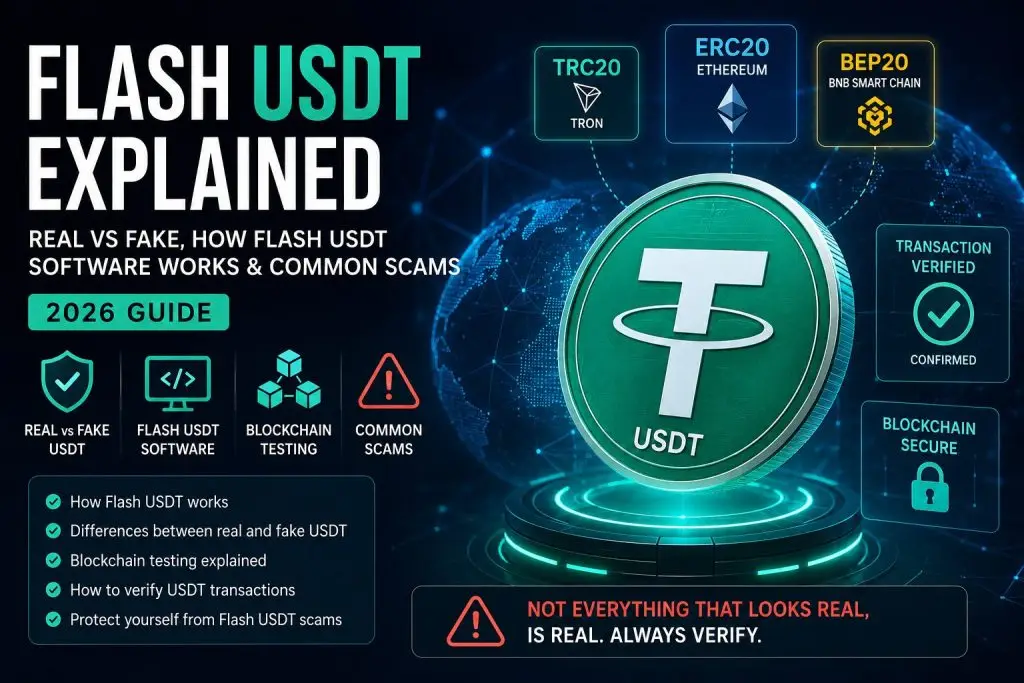
This guide explains what Flash USDT is, how it differs from genuine Tether (USDT), where blockchain testing fits in, and how to recognize common scams so you can make informed decisions.
Table of Contents
- What Is Flash USDT?
- Is Flash USDT Real?
- Flash USDT vs Real USDT
- What Is Flash USDT Software?
- How Blockchain Testing Works
- Flash USDT TRC20, ERC20 & BEP20
- Common Flash USDT Scams
- Can Flash USDT Be Used on Binance?
- Can Flash USDT Be Converted Into Real USDT?
- How to Verify a USDT Transaction
- Frequently Asked Questions
What Is Flash USDT?
The phrase Flash USDT does not have a single universally accepted definition.
Depending on the context, it may refer to:
- Simulated USDT transactions used in controlled blockchain testing environments.
- Software marketed for educational demonstrations of token transfers.
- Claims of temporary wallet balances that appear real but are not spendable.
- Fraudulent schemes where fake or simulated balances are presented as genuine USDT.
Because these meanings are often mixed together online, it’s important to understand which one is being discussed before relying on any claims.
What Is Real USDT?
To understand Flash USDT, you first need to understand real USDT.
USDT (Tether) is a stablecoin issued by Tether Operations Limited and designed to maintain a value close to one U.S. dollar. It exists on several blockchain networks, including:
- TRON (TRC20)
- Ethereum (ERC20)
- BNB Smart Chain (BEP20)
- Solana
- Avalanche
- Polygon
- TON and other supported networks
Every genuine USDT transaction is permanently recorded on the blockchain and can be independently verified using a blockchain explorer.
When you receive authentic USDT, the transfer becomes part of the blockchain’s permanent transaction history.
Is Flash USDT Real?
This is one of the most searched questions on Google.
The answer depends on what someone means by “Flash USDT.”
If the term refers to real USDT on a public blockchain, then authentic USDT is real and verifiable.
If the term refers to temporary balances, fake tokens, or software claiming to create spendable USDT without a genuine blockchain transaction, those claims should be treated with extreme caution.
A useful way to think about it is:
| Real USDT | Flash USDT (as commonly advertised) |
|---|---|
| Recorded permanently on a blockchain | May involve simulations or claims that are not reflected as genuine on-chain assets |
| Can be independently verified | Claims should always be verified using trusted blockchain explorers |
| Accepted by compatible wallets and exchanges | May not be recognized or accepted by exchanges or other services |
| Backed by valid blockchain transactions | May rely on demonstrations, test environments, or misleading representations |
Always verify the transaction rather than relying on screenshots or wallet balances alone.
Why Is Flash USDT So Popular?
Several factors have contributed to the popularity of Flash USDT searches:
Cryptocurrency Education
Developers and students often explore blockchain concepts through testing environments before deploying real applications.
Demo Transactions
Some educational software demonstrates how token transfers appear, helping users understand blockchain mechanics without using real funds.
Online Marketing
Many websites advertise Flash USDT software using exaggerated claims that attract attention from people searching for quick ways to generate cryptocurrency.
Scams
Unfortunately, scammers frequently misuse the term “Flash USDT” to convince victims that they have received real cryptocurrency, encouraging them to release goods, services, or real digital assets.
Flash USDT vs Real USDT
Understanding the differences helps avoid confusion.
Real USDT
Real USDT:
- Exists on supported blockchain networks.
- Has a verifiable transaction history.
- Can be checked through public blockchain explorers.
- Is recognized by compatible wallets and exchanges.
Flash USDT
The term Flash USDT may refer to:
- Demonstration transactions.
- Educational simulations.
- Test environments.
- Misleading claims involving temporary or fake balances.
Whenever someone claims to have sent Flash USDT as payment, independently verify the transaction before assuming funds have actually been received.
Understanding Blockchain Networks
USDT exists on multiple blockchain networks.
The most common include:
TRC20
Built on the TRON blockchain.
Known for:
- Lower transaction fees.
- Faster confirmations.
- Popular exchange support.
ERC20
Built on Ethereum.
Commonly used by:
- DeFi platforms.
- Smart contracts.
- Decentralized exchanges.
Transaction fees can be higher depending on network activity.
BEP20
Runs on BNB Smart Chain.
Offers:
- Fast transfers.
- Lower transaction costs.
- Broad compatibility with many wallets.
Regardless of the network, authentic transactions should always be verifiable on the corresponding blockchain explorer.
Why Verification Matters
One of the biggest mistakes users make is trusting:
- Screenshots.
- Videos.
- Edited wallet interfaces.
- Messages claiming payment has been sent.
Instead, verify every transaction by checking:
- Transaction Hash (TXID)
- Sending address
- Receiving address
- Blockchain network
- Confirmation status
A genuine blockchain transaction leaves a permanent record that anyone can inspect using a trusted blockchain explorer.
What Is Flash USDT Software?
One of the most searched phrases on Google today is “Flash USDT software.” You’ll find websites, videos, GitHub repositories, Telegram channels, and marketplace listings claiming to offer software that can “flash” USDT on blockchain networks such as TRC20, ERC20, and BEP20.
Because these claims vary widely, it’s important to understand what people mean by Flash USDT software and how it differs from genuine blockchain transactions.
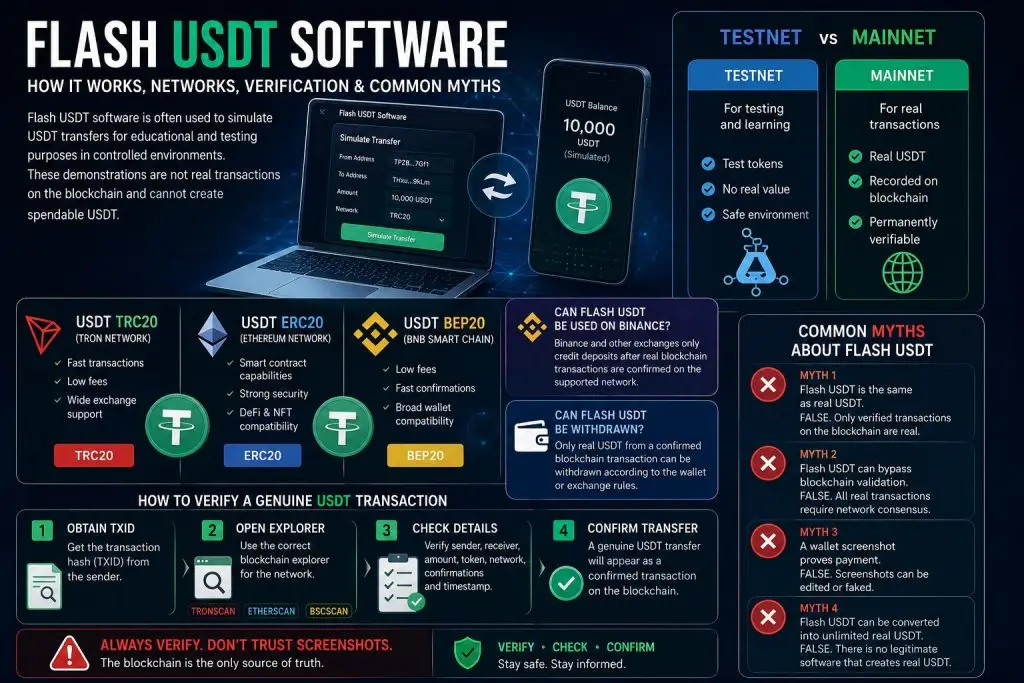
In legitimate blockchain education, some software is designed to simulate token transfers in controlled environments. These demonstrations help developers and students understand wallet interactions, transaction flows, and smart contract behavior without risking real assets.
However, there are also products and services marketed with exaggerated or misleading claims. Users should carefully distinguish educational demonstrations from promises that software can create spendable USDT or bypass blockchain validation.
How Does Flash USDT Software Work?
The term Flash USDT software is commonly used to describe applications that simulate or demonstrate cryptocurrency transfers.
Depending on the software, features may include:
- Simulated wallet-to-wallet transfers
- Blockchain transaction demonstrations
- Educational testing environments
- Wallet interface demonstrations
- Smart contract testing
- Training exercises for blockchain developers
These demonstrations are intended to help users learn how cryptocurrency systems operate rather than create genuine blockchain assets.
Blockchain Testing vs Real Blockchain Transactions
Many beginners confuse blockchain testing with real cryptocurrency transfers.
There is an important difference.
Testnet
A testnet is a blockchain network created specifically for developers.
Its purpose is to allow developers to:
- Test smart contracts
- Build decentralized applications (dApps)
- Experiment safely
- Learn blockchain programming
- Simulate cryptocurrency transfers
Testnet tokens are designed for testing and generally have no real-world monetary value.
Mainnet
A mainnet is the live blockchain used for actual cryptocurrency transactions.
When someone sends genuine USDT on the mainnet:
- The transaction is permanently recorded.
- Network validators confirm the transfer.
- The transaction receives confirmations.
- Anyone can independently verify it using a blockchain explorer.
Mainnet transactions involve real digital assets and cannot simply be simulated.
Flash USDT TRC20 Explained
Many online searches include:
- Flash USDT TRC20
- TRC20 Flash Software
- Flash TRON USDT
TRC20 refers to the TRON blockchain standard used by USDT.
Because TRON offers:
- Fast confirmations
- Low transaction fees
- Wide exchange support
it has become one of the most popular networks for USDT transfers.
Whether a transaction uses TRC20, ERC20, or BEP20, it should always be independently verifiable through the appropriate blockchain explorer.
Flash USDT ERC20
ERC20 USDT operates on the Ethereum blockchain.
Ethereum provides:
- Smart contract functionality
- Decentralized Finance (DeFi)
- NFT compatibility
- Enterprise-grade blockchain infrastructure
Real ERC20 USDT transactions are recorded permanently on Ethereum and can be verified through public blockchain explorers.
Flash USDT BEP20
BEP20 USDT uses BNB Smart Chain.
Advantages include:
- Lower transaction fees
- Faster confirmation times
- Broad wallet compatibility
Like other supported networks, genuine BEP20 transfers create permanent blockchain records that anyone can inspect.
Can Flash USDT Be Used on Binance?
One of Google’s most common questions is:
Can Flash USDT be used on Binance?
Major cryptocurrency exchanges such as Binance verify deposits against actual blockchain transactions.
Deposits must meet the exchange’s supported network requirements and be confirmed on the relevant blockchain before they are credited to a user’s account.
If someone claims to have sent you USDT, you should always verify the transaction independently rather than relying on screenshots or messages alone.
Can Flash USDT Be Withdrawn?
Another common question is:
Can Flash USDT be withdrawn?
The answer depends entirely on whether the balance represents a genuine blockchain transaction.
If a wallet reflects a valid, confirmed USDT transfer on a supported blockchain, the funds may be transferable according to the wallet or exchange’s rules.
If the displayed balance comes from a simulation, demonstration, or misleading representation rather than a confirmed blockchain transaction, it will not function like genuine USDT.
Always verify the transaction hash (TXID) and confirmation status before assuming funds are available.
Why Do Some Wallet Balances Appear Temporarily?
Users occasionally report seeing a balance appear briefly before disappearing or becoming unavailable.
Possible explanations include:
- Test environments
- Wallet synchronization issues
- Display glitches
- Unsupported token imports
- Custom token entries
- Misleading interfaces used in scams
A wallet display alone is not proof that a blockchain transaction has occurred.
The blockchain itself remains the authoritative source of truth.
How to Verify a Genuine USDT Transaction
Before accepting cryptocurrency as payment, verify the transaction independently.
Step 1 — Obtain the Transaction Hash (TXID)
Every legitimate blockchain transfer generates a unique transaction identifier.
Step 2 — Open the Correct Blockchain Explorer
Choose the explorer that matches the blockchain:
- TRON → TRONSCAN
- Ethereum → Etherscan
- BNB Smart Chain → BscScan
Step 3 — Check Transaction Details
Verify:
- Sender address
- Receiver address
- Token type
- Amount
- Confirmation status
- Timestamp
- Network
Step 4 — Confirm the Transfer
A genuine USDT transfer should appear as a confirmed transaction on the appropriate blockchain explorer.
If no matching transaction exists, investigate further before assuming payment has been received.
Common Myths About Flash USDT
The internet contains many claims that can confuse new cryptocurrency users.
Myth 1: Flash USDT Is the Same as Real USDT
False.
Real USDT exists as verified tokens on supported blockchains. Demonstrations, simulations, or unsupported claims should not be treated as equivalent.
Myth 2: Flash USDT Can Bypass Blockchain Validation
False.
Legitimate blockchain networks require consensus and validation before transactions become part of the permanent ledger.
Myth 3: Any Wallet Screenshot Proves Payment
False.
Screenshots can be edited or taken out of context.
Always verify transactions using independent blockchain explorers.
Myth 4: Flash USDT Can Be Converted into Unlimited Real USDT
Claims like this should be treated with skepticism. Authentic USDT is issued and tracked on supported blockchains, and there is no legitimate method for software to create spendable USDT outside those systems.
Why Learning Blockchain Verification Is Essential
Whether you’re a trader, investor, merchant, freelancer, or cryptocurrency beginner, understanding how to verify blockchain transactions can help you:
- Confirm payments independently.
- Detect suspicious claims.
- Reduce the risk of fraud.
- Understand wallet activity.
- Build confidence when using digital assets.
The blockchain is designed to provide transparency, making transaction verification one of the most valuable skills for anyone working with cryptocurrency.
Flash USDT Scams Explained: How Scammers Trick Victims Using Fake USDT
As Flash USDT has gained popularity online, scammers have increasingly exploited the term to deceive cryptocurrency users. Every day, victims report losing Bitcoin, USDT, Ethereum, and other digital assets after being shown convincing screenshots, fake wallet balances, or fabricated blockchain transactions.
Understanding these scams is one of the best ways to protect yourself.
The common factor in almost every Flash USDT scam is that the victim is persuaded to believe they have received genuine cryptocurrency when, in reality, the transaction cannot be independently verified on the blockchain.
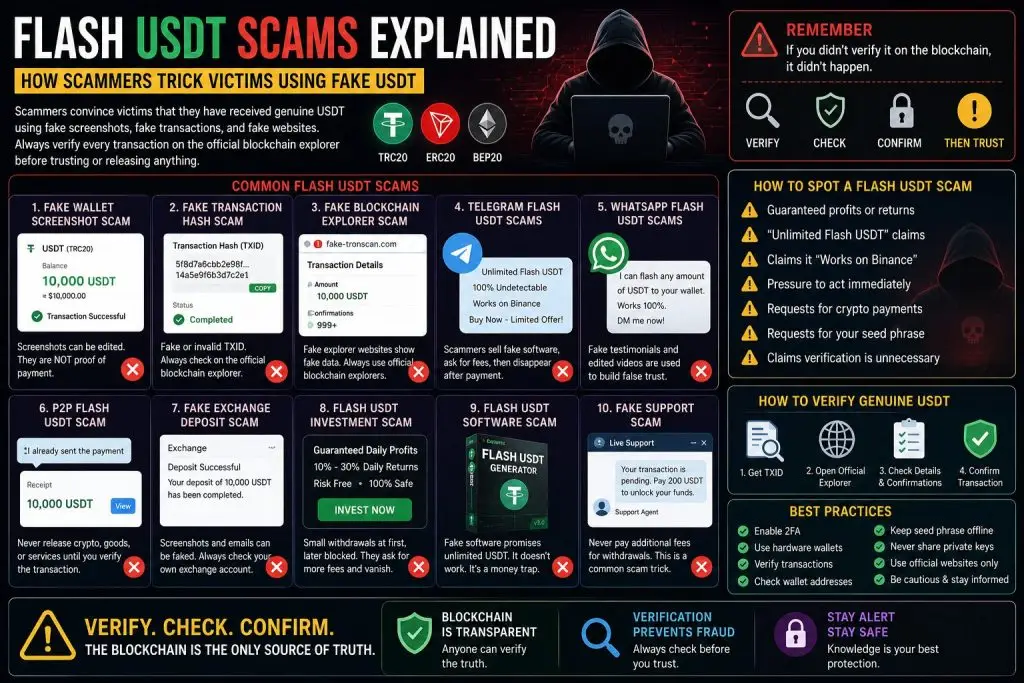
How Flash USDT Scams Work
Most Flash USDT scams follow a similar pattern.
A scammer may:
- Claim to have sent payment.
- Show a wallet screenshot displaying a large USDT balance.
- Send a fake transaction receipt.
- Direct the victim to a counterfeit blockchain explorer.
- Pressure the victim into releasing goods, services, or real cryptocurrency before verifying the transaction.
Because blockchain transactions are transparent, the safest practice is to verify every transfer independently instead of relying on images or messages.
Fake Wallet Screenshot Scam
One of the oldest cryptocurrency scams involves edited wallet screenshots.
A scammer sends an image showing:
- 10,000 USDT received
- Transaction completed
- Wallet balance increased
- Confirmation message
The screenshot may appear genuine.
However:
- Screenshots can be edited.
- Wallet interfaces can be manipulated.
- Images provide no proof that a blockchain transaction actually occurred.
Always verify:
✔ Transaction Hash (TXID)
✔ Wallet Address
✔ Blockchain Explorer
Never rely solely on screenshots.
Fake Transaction Hash Scam
Another common trick involves sending victims a fake transaction ID.
At first glance it may appear legitimate.
Before accepting payment:
Check:
- Does the TXID exist?
- Does it appear on the official blockchain explorer?
- Does the receiving address match yours?
- Is the token genuine USDT?
- Has the transaction received confirmations?
If the transaction cannot be verified independently, treat it as suspicious.
Fake Blockchain Explorer Scam
Some scammers create websites that imitate legitimate blockchain explorers.
These fake websites may display:
- Fake confirmations
- Fake wallet balances
- Fake timestamps
- Fake transaction history
To avoid this:
Always use trusted blockchain explorers for the relevant network.
Examples include:
- TRONSCAN (TRON)
- Etherscan (Ethereum)
- BscScan (BNB Smart Chain)
Never rely on links sent by strangers without verifying the website address.
Telegram Flash USDT Scams
Telegram has become a common platform for cryptocurrency fraud.
Typical scam claims include:
- “Unlimited Flash USDT.”
- “Lifetime Flash Software.”
- “100% Undetectable Flash.”
- “Generate Millions in Minutes.”
- “Works on Binance.”
Victims are often asked to:
- Purchase software.
- Pay activation fees.
- Buy licenses.
- Join premium groups.
After payment:
- The seller disappears.
- The software never arrives.
- The program does not function as advertised.
- Additional payments are requested.
Be cautious of anyone promising guaranteed financial gains or software that creates spendable USDT outside legitimate blockchain processes.
WhatsApp Flash USDT Scams
Scammers also use WhatsApp to promote Flash USDT offers.
Common tactics include:
- Fake testimonials.
- Edited transaction videos.
- Claims of successful withdrawals.
- Screenshots of enormous profits.
- Limited-time discounts.
Many victims trust these promotions because they appear to come from real users.
Always verify claims through independent sources before making financial decisions.
Flash USDT P2P Scam
Peer-to-peer cryptocurrency trading requires trust.
Some fraudsters exploit this by claiming payment has already been made.
They may provide:
- Fake receipts.
- Fake confirmations.
- Wallet screenshots.
- Edited videos.
- Fake blockchain explorer links.
Never release:
- Bitcoin
- USDT
- Ethereum
- Goods
- Digital services
until you have independently verified the transaction on the appropriate blockchain.
Fake Exchange Deposit Scam
Another common scam targets cryptocurrency merchants.
The scammer claims:
“I’ve already deposited the USDT.”
They then provide:
- Deposit screenshots.
- Email confirmations.
- Wallet balance images.
Instead of checking screenshots:
Log in to your own exchange account.
Verify whether the deposit has actually been credited.
Exchanges rely on confirmed blockchain transactions—not images.
Flash USDT Investment Scam
Some fraudulent investment websites advertise:
- Flash USDT trading
- Guaranteed daily profits
- Unlimited returns
- Automated blockchain income
- Flash mining
Victims are encouraged to deposit genuine cryptocurrency.
Initially:
- Small withdrawals may succeed.
Later:
- Withdrawals become blocked.
- Additional “unlock fees” are requested.
- Customer support disappears.
Remember that promises of guaranteed or unusually high returns are common warning signs of investment fraud.
Flash USDT Software Sales Scam
Another variation involves selling expensive software.
Advertisements claim the software can:
- Generate unlimited USDT.
- Produce undetectable blockchain transactions.
- Create permanent wallet balances.
- Bypass exchanges.
- Work on every blockchain.
These claims should be approached with caution.
Blockchain networks use consensus mechanisms and verification processes that cannot simply be bypassed by consumer software.
How to Spot a Flash USDT Scam
Watch for these warning signs.
🚩 Guaranteed profits.
🚩 Guaranteed recovery.
🚩 “Unlimited Flash USDT.”
🚩 “Works on Binance.”
🚩 Pressure to act immediately.
🚩 Requests for cryptocurrency payments before demonstrating legitimacy.
🚩 Requests for your wallet recovery phrase.
🚩 Claims that verification is unnecessary.
If several of these warning signs appear together, pause and investigate further before proceeding.
How to Verify Genuine USDT
Before accepting any cryptocurrency payment:
Verify the Blockchain
Check:
✔ Transaction Hash
✔ Receiving Address
✔ Sending Address
✔ Token Contract
✔ Number of Confirmations
✔ Blockchain Network
✔ Timestamp
Independent verification is always more reliable than screenshots or chat messages.
Best Practices for Protecting Yourself
Good security habits significantly reduce your exposure to cryptocurrency scams.
- Enable two-factor authentication (2FA).
- Use hardware wallets for long-term storage.
- Download wallet software only from official sources.
- Double-check wallet addresses before sending funds.
- Verify blockchain transactions independently.
- Keep your recovery phrase offline.
- Never share your seed phrase or private keys.
- Be cautious of unsolicited investment opportunities or software claims.
Why Blockchain Transparency Matters
One of blockchain’s greatest strengths is transparency.
Every confirmed transaction creates a permanent record that anyone can verify using the appropriate blockchain explorer.
Learning how to inspect transaction details, wallet addresses, and confirmation status allows users to distinguish between genuine blockchain activity and misleading claims.
This transparency is one of the reasons blockchain technology is trusted for recording digital asset transfers.
Frequently Asked Questions About Flash USDT
This section answers the most common Google “People Also Ask” questions while providing accurate, educational information. It is designed to help the article compete for AI Overviews and featured snippets.
How Much Is Flash USDT?
One of the most searched questions is:
How much is Flash USDT?
There is no official market price for “Flash USDT” because it is not a recognized cryptocurrency or separate digital asset issued by Tether.
You may find websites advertising Flash USDT software, licenses, subscriptions, or demonstrations with different prices. These prices relate to the software or service being sold—not to an officially recognized cryptocurrency called “Flash USDT.”
Always research carefully before purchasing software that makes extraordinary claims about creating or generating cryptocurrency.
Where Can I Get Flash USDT?
Some websites, online marketplaces, and messaging platforms advertise Flash USDT software or related services.
Before downloading or purchasing anything:
- Research the provider.
- Read independent reviews.
- Verify the software’s intended purpose.
- Avoid websites requesting your recovery phrase or private keys.
- Be cautious of promises that sound too good to be true.
If your goal is to learn blockchain development, there are many legitimate educational resources and test environments available that do not require misleading marketing.
Can Flash USDT Be Used on Binance?
Many people ask:
Does Binance accept Flash USDT?
Major cryptocurrency exchanges credit deposits based on valid blockchain transactions that meet their supported network and asset requirements.
If a transaction cannot be verified on the blockchain, it will generally not be treated as a standard USDT deposit.
Before sending cryptocurrency to any exchange, always verify:
- Supported blockchain network
- Deposit address
- Token standard
- Confirmation requirements
Can Flash USDT Be Converted Into Real USDT?
This question appears frequently in search results.
There is no legitimate process that converts simulated balances or unsupported representations into genuine USDT simply by pressing a button or paying a fee.
Authentic USDT exists as blockchain-recorded tokens issued on supported networks. If someone claims they can transform “Flash USDT” into spendable USDT for a payment, approach that claim with caution and verify it through trusted sources.
Does Flash USDT Expire?
You may encounter claims that Flash USDT remains visible for:
- 24 hours
- 30 days
- 90 days
- 365 days
The answer depends entirely on what is being described.
In legitimate blockchain testing environments, demonstration tokens and simulations behave according to the rules of the environment in which they are created.
For real USDT on public blockchains, confirmed transactions become part of the permanent blockchain history and do not “expire” in the way promotional claims often suggest.
Is Flash USDT Legal?
The legality depends on how software or demonstrations are used.
Educational blockchain testing, smart contract development, and software demonstrations are legitimate activities.
However, attempting to represent simulated balances as genuine cryptocurrency in commercial transactions, peer-to-peer trades, or investments may violate laws and platform policies.
Always use blockchain tools responsibly and transparently.
Flash USDT vs Real USDT
| Feature | Real USDT | Flash USDT (Common Usage) |
|---|---|---|
| Officially issued by Tether | ✔ Yes | Not necessarily |
| Recorded permanently on blockchain | ✔ Yes | Depends on the context; demonstrations and simulations may not create genuine on-chain assets |
| Accepted by major exchanges | ✔ When supported and verified | Claims should be independently verified |
| Independently verifiable | ✔ Yes | Verify using trusted blockchain explorers |
| Used for real transactions | ✔ Yes | Educational demonstrations and unsupported claims should not be confused with genuine payments |
How to Verify Any USDT Transaction
Before accepting cryptocurrency as payment, follow this checklist.
✔ Verify the Transaction Hash (TXID)
Every genuine blockchain transaction has a unique transaction identifier.
✔ Check the Blockchain Explorer
Use the explorer that matches the blockchain:
- TRON → TRONSCAN
- Ethereum → Etherscan
- BNB Smart Chain → BscScan
- Solana → Solscan
✔ Verify the Receiving Address
Ensure the destination address matches the wallet you control or expect to receive funds in.
✔ Check Confirmations
A confirmed transaction should show confirmation status on the blockchain explorer.
✔ Verify the Token
Check that the transferred asset is the expected USDT token on the intended network.
Common Flash USDT Myths
Myth 1
Flash USDT creates unlimited real USDT.
Reality: Genuine USDT is issued on supported blockchains and should always be independently verifiable.
Myth 2
Wallet screenshots prove payment.
Reality: Screenshots can be edited or misrepresented. Always verify on the blockchain.
Myth 3
Flash USDT bypasses blockchain validation.
Reality: Public blockchains rely on consensus and transaction validation before recording transfers.
Myth 4
Every Flash USDT tool is a scam.
Reality: Some software is designed for demonstrations or education. The important distinction is whether it is accurately represented and not used to mislead others.
Tips for Staying Safe
Protect yourself by following these best practices:
- Verify every transaction independently.
- Use official wallet software.
- Enable two-factor authentication.
- Store recovery phrases offline.
- Be cautious of unsolicited offers.
- Double-check wallet addresses before sending funds.
- Keep software up to date.
- Learn how blockchain explorers work.
Knowledge is one of the strongest defenses against cryptocurrency fraud.
Helpful Resources
For learning more about blockchain technology and wallet security, consider these authoritative resources:
- Tether (Official): https://tether.to
- Tether Token Recoveries: https://tether.to/en/recoveries
- Binance Academy: https://academy.binance.com
- TRONSCAN: https://tronscan.org
- Etherscan: https://etherscan.io
- BscScan: https://bscscan.com
- Solscan: https://solscan.io
These resources provide educational information about supported blockchain networks, wallet verification, and transaction analysis.
Explore additional educational guides on USDT Recovery Pro:
- Bitcoin Recovery Guides: https://usdt-recoverypro.com/lost-wallets/
- /usdt-recoverypro.com/
Building internal links between related articles strengthens your site’s topical authority and helps visitors find more relevant content.
Conclusion
Flash USDT is a term that is used in several different ways across the cryptocurrency industry, ranging from educational blockchain demonstrations to misleading marketing and fraudulent schemes. Understanding the difference between genuine USDT transactions and unsupported claims is essential for protecting your digital assets and making informed decisions.
Before accepting cryptocurrency as payment or downloading software advertised as “Flash USDT,” always verify transactions using trusted blockchain explorers, confirm wallet addresses, and rely on official resources. Screenshots, videos, or chat messages should never replace independent blockchain verification.
If your goal is to learn about blockchain technology, focus on legitimate educational tools, official wallet applications, and recognized testing environments. If you believe you have been targeted by a cryptocurrency scam or have lost USDT, preserve your transaction records, secure your accounts, and consult trusted resources to understand your available options.
By combining blockchain knowledge with careful verification and strong security practices, you can significantly reduce your risk of fraud and navigate the cryptocurrency ecosystem with greater confidence.