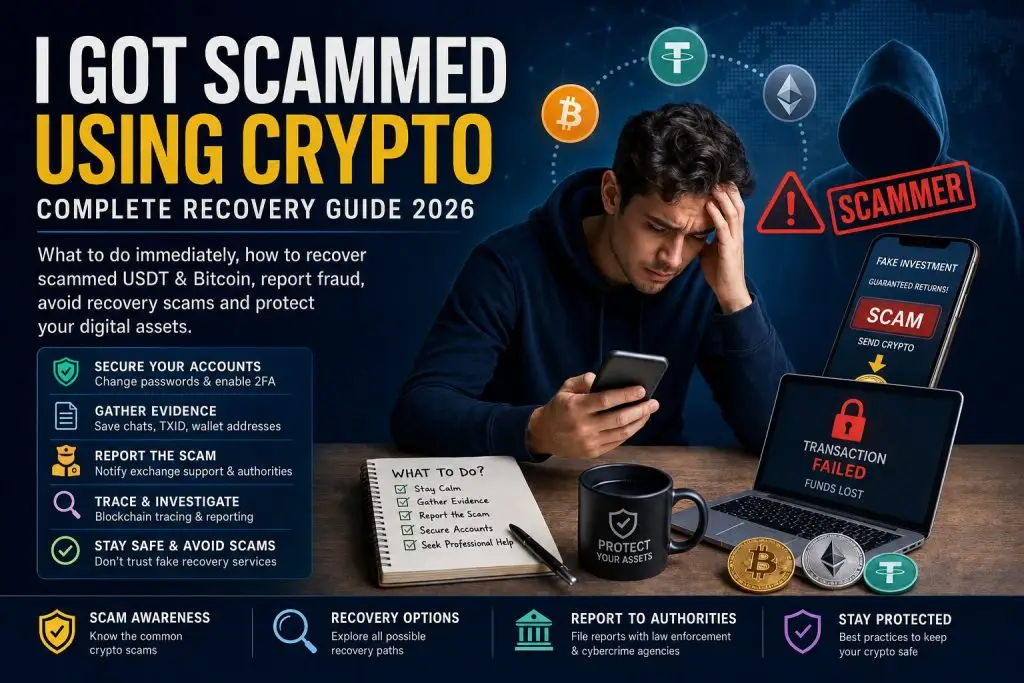
Have you found yourself thinking, “I got scammed using crypto—what do I do now?” If so, you’re not alone. Every day, people lose Bitcoin, USDT, Ethereum, XRP, and other digital assets through fake investment platforms, phishing websites, impersonation scams, fraudulent customer support, romance scams, and counterfeit wallet applications.
The first few hours after discovering a scam are critical. While cryptocurrency transactions recorded on public blockchains are generally irreversible, quick action can help protect your remaining assets, preserve evidence, and, in some situations, improve the chances of an investigation or recovery effort.
This guide brings together the questions people ask most often, including:
- I got scammed on Binance.
- I got scammed on Trust Wallet.
- I got scammed on Ledger.
- I got scammed on Exodus.
- How can I recover my scammed USDT?
- Can Binance recover stolen funds?
- Can Trust Wallet recover lost funds?
- Can crypto transactions be reversed?
- How do I report a crypto scam?
- How do I avoid recovery scams?
Instead of focusing on only one wallet, exchange, or cryptocurrency, this guide explains the practical steps that apply across many common situations.
First: Stay Calm and Protect Your Remaining Assets
After discovering a scam, it’s easy to panic. However, rushing into another decision can make the situation worse. Many victims lose additional funds because they trust the first person who promises a quick recovery.
Start by protecting what you still control.
If you still have access to your exchange account or wallet:
- Change your passwords immediately.
- Enable two-factor authentication (2FA) if it is not already enabled.
- Review connected devices and active sessions.
- Revoke unnecessary wallet permissions where applicable.
- Move any remaining assets to a secure wallet if you believe your current wallet has been compromised.
What Type of Crypto Scam Happened?
I Got Scammed Using Crypto: What Happens Next?
The recovery steps depend on how the loss occurred.
Common scenarios include:
Exchange Scam
Examples:
- Fake Binance support.
- Fake Coinbase support.
- Fraudulent trading platforms.
- P2P payment fraud.
Wallet Scam
Examples:
- Trust Wallet phishing.
- MetaMask wallet drainer.
- Fake Ledger Live application.
- Exodus impersonation.
Investment Scam
Examples:
- Fake crypto investment websites.
- Guaranteed return schemes.
- Fake mining platforms.
- AI trading bot scams.
Social Engineering Scam
Examples:
- Telegram impersonation.
- WhatsApp investment groups.
- Romance scams.
- Fake recovery companies.
Transaction Error
Examples:
- Sent USDT to the wrong address.
- Wrong blockchain network.
- Wrong destination wallet.
- Missing memo or tag.
Each scenario requires a slightly different response, which we’ll cover throughout this guide.
Can Cryptocurrency Be Recovered?
I Got Scammed Using Crypto on Binance
One of the biggest misconceptions is that all cryptocurrency losses can either always—or never—be recovered.
The reality is more nuanced.
Recovery depends on factors such as:
- How the assets were lost.
- Whether you still control your wallet.
- Whether the receiving platform is a regulated exchange.
- How quickly the incident is reported.
- The quality of the evidence available.
- Whether law enforcement or the receiving platform can take action.
For example:
- If you forgot your wallet password but still have the recovery phrase, you may be able to restore access.
- If you sent funds to the wrong address on a public blockchain, the transaction itself generally cannot be reversed.
- If stolen funds reach a cooperating exchange, there may be opportunities for investigation, depending on the circumstances and applicable legal processes.
Understanding these distinctions helps set realistic expectations.
The First 10 Things You Should Do
If you’ve just realized you were scammed:
- Stop communicating with the scammer.
- Save all chat messages and emails.
- Record the transaction hash (TXID).
- Copy the wallet addresses involved.
- Take screenshots of relevant evidence.
- Secure your exchange and wallet accounts.
- Report the incident to the platform involved.
- File a report with the appropriate authorities in your jurisdiction.
- Monitor your accounts for further suspicious activity.
- Be cautious of anyone promising guaranteed recovery for an upfront fee.
Why Evidence Matters
Many people focus only on the amount they lost.
Investigators often focus on the details surrounding the incident, including:
- Transaction IDs.
- Wallet addresses.
- Dates and times.
- Website URLs.
- Email addresses.
- Usernames.
- Chat logs.
- Screenshots.
- Payment confirmations.
Keeping organized records can make it easier to explain what happened to an exchange, law enforcement, or other legitimate parties.
The Biggest Mistake Victims Make
Unfortunately, many victims are targeted twice.
After posting online or joining recovery groups, they are contacted by individuals claiming they can:
- Hack the blockchain.
- Reverse transactions instantly.
- Recover every stolen coin.
- Access private wallets without authorization.
Be skeptical of anyone making guarantees or requesting payment before providing verifiable evidence of their services.
What You’ll Learn in This Guide
Over the next sections, you’ll learn:
- What to do if you were scammed on Binance.
- How Trust Wallet scams work.
- How Ledger phishing attacks happen.
- How Exodus scams operate.
- Whether USDT can be recovered.
- Whether Bitcoin can be recovered.
- How blockchain tracing works.
- How to report stolen cryptocurrency.
- How to avoid recovery scams.
- Best practices to protect your digital assets in the future.
This guide is designed to answer the questions people ask after a cryptocurrency scam while providing practical, evidence-based guidance that helps you make informed decisions.
I Got Scammed on Binance, Trust Wallet, Ledger, Exodus & Other Crypto Platforms: What to Do Next
If you’ve reached this point, you’ve probably already searched for phrases like “I got scammed on Binance,” “Can Binance recover stolen funds?” “Can Trust Wallet recover lost funds?” or “How can I recover my scammed USDT?”
The good news is that you’re asking the right questions.
The reality is that not every crypto scam is the same, and the platform involved can influence what practical steps are available. Understanding how the scam happened will help you prioritize the right actions, preserve evidence, and avoid making the situation worse.
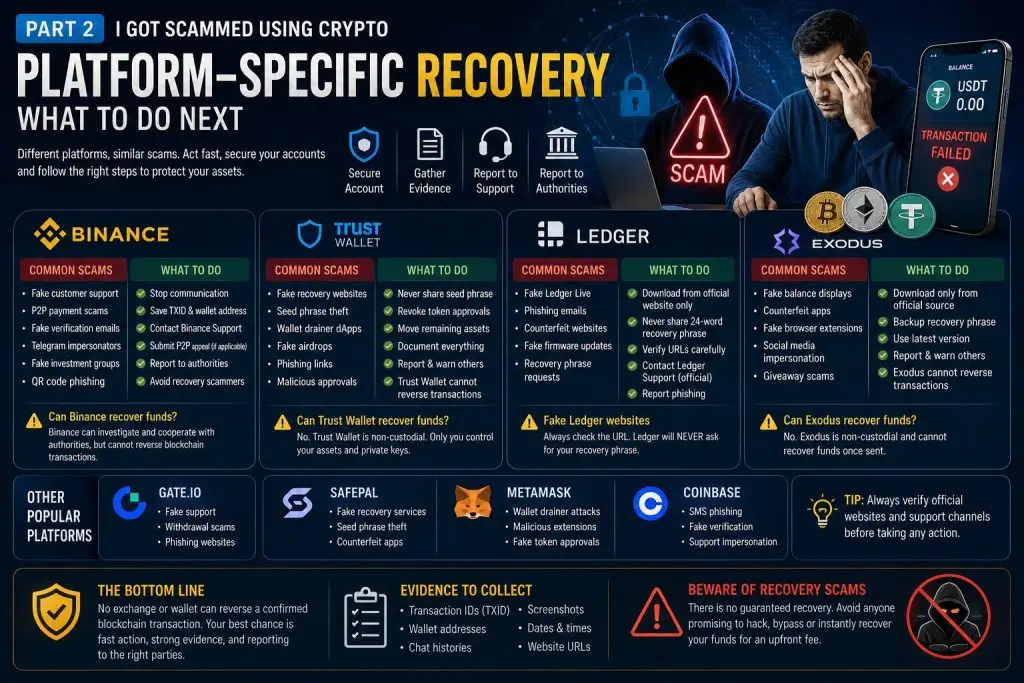
I Got Scammed on Binance
I Got Scammed Using Crypto
Binance is one of the world’s largest cryptocurrency exchanges, making it a common target for scammers who impersonate customer support, create fake websites, or exploit peer-to-peer (P2P) transactions.
Common Binance Scams
- Fake Binance customer support
- Binance P2P payment scams
- Fake Binance verification emails
- Telegram impersonators
- WhatsApp investment groups
- Fake trading signal providers
- QR code phishing scams
- API key theft
- Fake Binance mobile apps
Many victims don’t lose funds because Binance itself was compromised—they lose funds because they unknowingly interacted with someone pretending to represent Binance or trusted a fraudulent investment opportunity.
How Can I Recover My Scammed USDT on Binance?
If your USDT was sent from your Binance account to a scammer, act quickly:
- Stop communicating with the scammer.
- Save the transaction ID (TXID).
- Record the destination wallet address.
- Export chat histories, emails, and screenshots.
- Contact Binance Support through the official website or app.
- If the incident involved Binance P2P, submit a formal appeal through the transaction.
- File a report with your local law enforcement or cybercrime authority.
If the stolen funds are transferred to another exchange that cooperates with investigations, timely reporting and complete evidence may assist any investigation. However, recovery is not guaranteed, and confirmed blockchain transactions generally cannot be reversed.
Can Binance Recover Stolen Funds?
This is one of the most searched questions online.
The answer depends on several factors:
Sometimes Binance can:
- Review reports involving accounts on its platform.
- Cooperate with law enforcement investigations.
- Help identify accounts associated with suspicious activity.
- Take action on accounts that violate its policies.
However, Binance cannot simply reverse a completed blockchain transaction because blockchain networks are decentralized.
The faster you report the incident and provide accurate evidence, the more useful your report may be.
Can Someone Reverse a Binance Transaction?
In most cases, no.
Once a cryptocurrency transaction is confirmed on the blockchain, it cannot simply be canceled like a credit card payment.
There are limited situations where exchanges, token issuers, or legal processes may become involved, but users should not expect a completed blockchain transfer to be reversible.
I Got Scammed on Trust Wallet
Trust Wallet is a self-custody wallet, meaning you control your private keys and recovery phrase.
Because of this, Trust Wallet cannot reverse transactions or restore funds after a confirmed transfer.
Common Trust Wallet Scams
- Fake wallet recovery websites
- Seed phrase theft
- Wallet drainer smart contracts
- I Got Scammed Using Crypto
- Fake airdrops
- Phishing links
- Fake browser extensions
- QR code scams
- Token approval scams
Can Trust Wallet Recover Lost Funds?
This is another question asked thousands of times.
The answer depends on what happened.
If you still have your recovery phrase:
You may be able to restore your wallet on another trusted device if you’ve lost access to the app.
If your wallet was drained after sharing your recovery phrase:
Unfortunately, anyone with your recovery phrase can control the wallet. Trust Wallet cannot take back funds that have already been transferred.
If you approved a malicious smart contract:
You should revoke unnecessary token approvals, move any remaining assets to a new wallet, and strengthen your security.
Can Someone Steal My Crypto Just From My Wallet Address?
Generally, no.
A public wallet address is designed to be shared so others can send cryptocurrency to you.
However, scammers can still:
- Monitor your transactions.
- Send scam tokens.
- Use address poisoning attacks.
- I Got Scammed Using Crypto
- Trick you into sending funds to lookalike addresses.
Your recovery phrase, private keys, or approval of malicious transactions pose much greater risks than simply sharing a wallet address.
I Got Scammed on Ledger
I Got Scammed Using Crypto and Lost USDT
Hardware wallets such as Ledger provide strong security, but scammers often target users through deception rather than by breaking the device itself.
Common Ledger Scams
- Fake Ledger Live downloads
- Phishing emails
- Counterfeit support websites
- Fake firmware updates
- Recovery phrase requests
- Social media impersonators
- I Got Scammed Using Crypto
A legitimate Ledger representative will never ask for your 24-word recovery phrase.
Fake Ledger Website Warning
Scammers create convincing websites that look almost identical to the official Ledger website.
Always verify the URL carefully before downloading software or entering account information.
Ledger Phishing Emails
Many phishing emails claim:
- Your wallet has been compromised.
- You must verify your account.
- Your assets will be frozen.
- I Got Scammed Using Crypto
- A security update is required immediately.
These messages are designed to create urgency.
Never enter your recovery phrase through a link received by email.
I Got Scammed on Exodus Wallet
I Got Scammed Using Crypto Through a Fake Investment Platform
Exodus is another popular self-custody wallet that is frequently targeted by phishing campaigns.
Common Exodus Scams
- Fake balance displays
- Counterfeit desktop applications
- Fake browser extensions
- Social media impersonation
- Giveaway scams
- Wallet recovery scams
- I Got Scammed Using Crypto
Can Exodus Recover Lost Funds?
Because Exodus is a non-custodial wallet, it does not hold your private keys.
This means:
- Exodus cannot reverse blockchain transactions.
- Exodus cannot restore funds sent to scammers.
- Exodus cannot recover assets after a compromised recovery phrase.
However, if you still control your recovery phrase, you may be able to restore your wallet on another trusted installation of Exodus.I Got Scammed Using Crypto
Other Popular Platforms Targeted by Scammers
Crypto scams are not limited to one exchange or wallet.
Users have also reported scams involving:
Gate.io
- Fake customer support
- Withdrawal scams
- Phishing websites
- Fake login pages
SafePal
- Fake recovery services
- Seed phrase theft
- Counterfeit applications
MetaMask
- Wallet drainer attacks
- Malicious browser extensions
- Fake token approvals
Coinbase
- SMS phishing
- Fake account verification
- Support impersonation
- Fake withdrawal alerts
- I Got Scammed Using Crypto
A Pattern You’ll Notice
Most successful crypto scams don’t rely on breaking blockchain technology.
Instead, they rely on:
- Human trust.
- Fake urgency.
- Social engineering.
- Impersonation.
- Phishing.
- Emotional manipulation.
Recognizing these tactics can help you avoid similar attacks in the future.
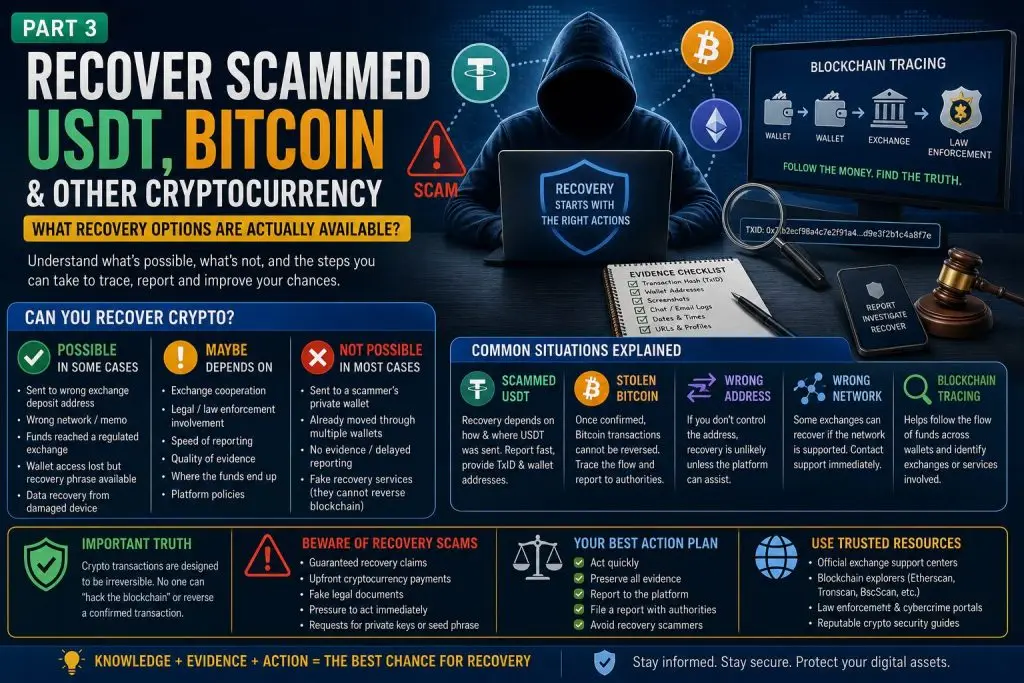
Recover Scammed USDT, Bitcoin & Other Cryptocurrency: What Recovery Options Are Actually Available?
If you’ve searched “I got scammed using crypto,” you’ve probably also come across promises like:
- “We can reverse any blockchain transaction.”
- “Download crypto recovery software.”
- “Recover your Bitcoin in 30 minutes.”
- “Hack the scammer’s wallet instantly.”
- “Recover any USDT with one click.”
These claims are often misleading. Cryptocurrency recovery is not about magically reversing transactions—it is about understanding what happened, preserving evidence, identifying possible recovery paths, and acting quickly where legitimate options exist.I Got Scammed Using Crypto
This section explains what is realistically possible depending on how your cryptocurrency was lost.
How Can I Recover Scammed USDT?
I Got Scammed Using Crypto: Can I Recover My Bitcoin?
This is one of the most searched questions on Google.
The answer depends entirely on how your USDT was lost.
Scenario 1: You Sent USDT to the Wrong Address
If you manually sent USDT to an incorrect blockchain address that you do not control, the blockchain transaction itself generally cannot be reversed.
However, if the receiving address belongs to a cryptocurrency exchange, reporting the incident quickly and providing complete transaction details may help the exchange review your case. Whether any action is possible depends on the exchange’s policies and the specific circumstancesI Got Scammed Using Crypto.
Scenario 2: Your USDT Was Stolen by a Scammer
Common examples include:
- Fake investment websites
- Fake mining platforms
- Romance scams
- WhatsApp investment groups
- Telegram impersonators
- Fake Binance customer support
- Fake Trust Wallet support
In these situations, it’s important to:
- Save the transaction hash (TXID).
- Record every wallet address involved.
- Preserve chats, emails, and screenshots.
- I Got Scammed Using Crypto
- Report the incident to the relevant platform and appropriate authorities.
- Be cautious of anyone claiming guaranteed recovery.
Scenario 3: USDT Sent on the Wrong Blockchain Network
Sometimes users send:
- ERC-20 USDT to a TRC-20 address.
- BEP-20 USDT to an ERC-20 address.
- Assets to an unsupported network on an exchange.
In some cases, if the receiving platform supports asset recovery for that network, assistance may be available. Recovery depends on the platform’s capabilities and policies, so contact the official support team as soon as possible.I Got Scammed Using Crypto
Can Stolen USDT Be Recovered?
Many people expect a simple yes-or-no answer.
The more accurate answer is:
Sometimes—but it depends on the circumstances.
Factors include:
- How quickly the incident was reported.
- Whether the funds reached a regulated exchange.
- The availability of transaction records.
- I Got Scammed Using Crypto
- The cooperation of relevant platforms.
- Any applicable legal or law enforcement processes.
There is no guarantee of recovery, and anyone promising certain results should be treated with caution.
What About Bitcoin?
Bitcoin works differently from traditional banking systems.
Once a Bitcoin transaction receives confirmations on the blockchain, it generally cannot be canceled or reversed.
However, recovery may still be possible in some situations.
Lost Wallet Password
If you still have:
- Your wallet file.
- Your recovery phrase.
- Partial password information.
- Old backups.
You may be able to restore access to your wallet.
Damaged Computer or Hard Drive
If your wallet was stored on damaged media, professional data recovery specialists may sometimes recover deleted or corrupted wallet files. Success depends on the condition of the storage device and whether the necessary wallet information still exists.I Got Scammed Using Crypto
Bitcoin Sent to a Scammer
If Bitcoin has already been transferred to a scammer’s wallet, the blockchain transaction itself is generally irreversible.
Your next steps should focus on:
- Preserving evidence.
- Identifying where the funds move.
- Reporting the incident to relevant exchanges if applicable.
- Filing reports with law enforcement.
- I Got Scammed Using Crypto
- Avoiding secondary recovery scams.
What Is Blockchain Tracing?
Blockchain tracing is the process of following cryptocurrency transactions through public blockchain records.
Analysts may examine:
- Wallet addresses.
- Transaction histories.
- Exchange deposits.
- Timing of transfers.
- Asset movement across wallets.
- Cross-chain activity where applicable.
The goal is to understand the flow of funds and identify whether they eventually reach services or platforms that may cooperate with lawful investigations.I Got Scammed Using Crypto
Blockchain tracing does not mean hacking wallets or reversing transactions.
Can Crypto Sent to the Wrong Address Be Recovered?
I Got Scammed Using Crypto: How Blockchain Tracing Works
Another common question.
If you control the receiving address, recovery may be straightforward.
If you do not control the destination address, recovery depends on factors such as:
- Whether the recipient cooperates.
- Whether the destination is an exchange.
- Whether the platform has an asset recovery process.
- Whether the transaction involved an unsupported network.
- I Got Scammed Using Crypto
Unfortunately, there is no technical method to force a blockchain transaction to reverse once it has been confirmed.
Can Cryptocurrency Transactions Be Reversed?
For most public blockchains:
No.
This applies to:
- Bitcoin
- Ethereum
- TRON
- Solana
- BNB Chain
- Polygon
- Avalanche
- XRP Ledger (confirmed transactions)
Once confirmed, transactions are designed to be permanent.
That permanence is one of blockchain technology’s core features.I Got Scammed Using Crypto
What Recovery Services Can Legitimately Do
Legitimate assistance focuses on investigation and documentation rather than making impossible promises.
Depending on the situation, this may include:
- Reviewing transaction records.
- Organizing evidence.
- Explaining blockchain activity.
- Identifying wallet movements using public blockchain data.
- Helping prepare reports for exchanges or law enforcement.
- Advising on practical next steps.
No reputable service should promise guaranteed recovery or claim it can simply “hack” the blockchain.
Beware of Fake Recovery Services
Sadly, many scam victims become victims again.
Warning signs include:
- Guaranteed recovery claims.
- Requests for upfront cryptocurrency payments with no clear process.
- Claims of secret blockchain hacks.
- Fake legal documents.
- Pressure to act immediately.
- Requests for your recovery phrase or private keys.
Protect yourself by verifying who you are dealing with and keeping control of your wallet credentials.
The Key Takeaway
Whether you lost USDT, Bitcoin, Ethereum, XRP, or another cryptocurrency, the first priorities are:
- Secure your remaining assets.
- Preserve all evidence.
- Report the incident to the relevant platforms and authorities.
- Understand the technical limits of blockchain transactions.
- Avoid recovery scams that prey on victims.
Taking informed, timely action gives you the best chance of protecting yourself and supporting any legitimate investigation.I Got Scammed Using Crypto
Frequently Asked Questions, How to Avoid Crypto Scams & Your Next Steps
I got scammed using crypto
If you’ve read this far, you now understand how cryptocurrency scams work, why blockchain transactions are generally irreversible, and what practical recovery options may exist depending on your situation.
This final section answers the most common questions people ask after searching “I got scammed using crypto” and provides a practical action plan to help you reduce future risk.I Got Scammed Using Crypto
I Got Scammed Using Crypto: Frequently Asked Questions
How can I recover my scammed USDT?
Recovery depends on how your USDT was lost.
If your USDT was:
- Sent to the wrong address
- Stolen through phishing
- Lost in a fake investment platform
- Sent during a Binance P2P scam
- Drained from your wallet
You should immediately:I Got Scammed Using Crypto
- Save the transaction hash (TXID)
- Record all wallet addresses
- Preserve screenshots and chat history
- Report the incident to the relevant exchange or wallet provider
- File a report with your local cybercrime authority
- Be cautious of anyone promising guaranteed recovery
Quick reporting improves the chances of preserving evidence and, in some cases, assisting legitimate investigations.
Can Binance Recover Stolen Funds?
Binance may investigate reports involving activity on its platform and cooperate with law enforcement where appropriate. However, Binance cannot simply reverse a confirmed blockchain transaction.I Got Scammed Using Crypto
The sooner you report suspicious activity and provide complete evidence, the more effectively Binance can review your case.
Can Trust Wallet Recover Lost Funds?
Trust Wallet is a self-custody wallet.
This means:
- You control your private keys.
- You control your recovery phrase.
- Trust Wallet cannot reverse completed blockchain transactions.
If you still have your recovery phrase, you may be able to restore your wallet. If the phrase has been compromised, however, anyone who has it may control the wallet.I Got Scammed Using Crypto
Can Someone Reverse a Crypto Transaction?
Generally, no.
Bitcoin, Ethereum, USDT (on supported blockchains), and most other cryptocurrencies are designed so that confirmed blockchain transactions are permanent.
This is why scammers often pressure victims into sending funds quickly.I Got Scammed Using Crypto
Can USDT Be Refunded?
USDT transactions are generally not refundable once confirmed on the blockchain.
In certain situations—such as issues involving exchanges, supported recovery processes, or lawful intervention—there may be additional options, but these depend on the facts of the case and should not be assumedI Got Scammed Using Crypto.
Can Stolen Bitcoin Ever Be Recovered?
Bitcoin itself cannot be “called back” after a confirmed transaction.
However:
- Lost wallets may sometimes be restored if recovery information still exists.
- Damaged storage devices may, in some cases, yield recoverable wallet files.
- Investigations can sometimes trace funds to regulated services, depending on how the assets move.
Each case is differentI Got Scammed Using Crypto.
Can Someone Steal Crypto With My Wallet Address?
Simply knowing your public wallet address does not allow someone to steal your cryptocurrency.
The real risks come from:
- Sharing your recovery phrase.
- Revealing private keys.
- Approving malicious smart contracts.
- Installing fake wallet software.
- Falling for phishing websites.
How Do I Report a Crypto Scam?
Document everything before deleting or changing anything.
Gather:
- Transaction IDs
- Wallet addresses
- Email conversations
- Screenshots
- Phone numbers
- Telegram or WhatsApp chats
- Website links
- Dates and times
Report the incident to:
- The exchange or wallet involved
- Your country’s cybercrime reporting authority
- Local law enforcement
- Other relevant authorities where appropriate
How to Avoid Becoming a Victim Again
Most cryptocurrency scams succeed because they exploit trust, urgency, or fear.
Protect yourself by following these best practices:
Always Verify Official Websites
Never click wallet or exchange links sent through:
- Telegram
- Discord
- Email messages
Instead, type the official website address directly into your browser.
Never Share Your Recovery Phrase
Your:
- 12-word phrase
- 24-word phrase
- Private keys
should never be shared with anyone.
No legitimate wallet provider, exchange, or support representative will ask for them.
Enable Strong Account Security
Protect your accounts with:
- Two-factor authentication (2FA)
- Strong, unique passwords
- Email security
- Login notifications
- Hardware security keys where available
Verify Every Transaction
Before sending cryptocurrency:
✔ Check the wallet address carefully.
✔ Verify the blockchain network.
✔ Confirm the amount.
✔ Double-check the recipient.
✔ Be cautious of address poisoning attacks.
Ignore Guaranteed Recovery Claims
If someone says:
- “We guarantee recovery.”
- “We’ll hack the blockchain.”
- “Pay us first.”
- “Recovery is 100% certain.”
Treat these claims with skepticism. Legitimate assistance should explain the process, limitations, and potential outcomes without making promises that cannot be guaranteedI Got Scammed Using Crypto.
Final Thoughts
Searching “I got scammed using crypto” is often the beginning of a stressful experience—but it can also be the start of making informed decisions.
By understanding how scams work, preserving evidence, reporting incidents promptly, and securing your remaining assets, you put yourself in the strongest possible position to respond.
Just as importantly, learning from the experience can help prevent future losses.
Helpful Resources
For additional information, you can consult official resources from:
- Binance Help Center
- Trust Wallet Support
- Ledger Academy
- Tether Knowledge Base
- Etherscan
- Tronscan
- BscScan
- Chainalysis educational resources
- Your local cybercrime reporting agency
Conclusion
Cryptocurrency offers speed, global accessibility, and financial freedom—but those same features make it attractive to scammers.
The best defense is education, careful verification, and prompt action if something goes wrong. Whether your loss involved Bitcoin, USDT, Ethereum, XRP, Binance, Trust Wallet, Ledger, or another platform, understanding the situation and following a structured response is far more effective than relying on unrealistic promises.