I Got Hacked: What Should I Do Immediately?
I got hacked. Those four words can instantly trigger panic, especially if you’ve lost access to your email, Facebook account, bank account, cryptocurrency wallet, or other important online accounts. The good news is that acting quickly can significantly reduce the damage and improve your chances of regaining control.
If I got hacked describes your situation today, don’t panic or make rushed decisions. Cybercriminals often rely on victims acting emotionally. Instead, follow a structured recovery plan to secure your accounts, protect your personal information, and prevent additional losses.
Whether your Facebook password has been changed, your Gmail account has been taken over, your Binance account shows unauthorized activity, or your cryptocurrency wallet has been compromised, the first hour after discovering the breach is critical.
This guide walks you through 21 essential recovery steps to help you respond effectively.
Why Do People Get Hacked?
Cybercriminals use many different techniques to gain access to personal and financial accounts. Understanding how attacks happen can help you recognize the warning signs and reduce the likelihood of future incidents.
Common attack methods include:
- Phishing emails pretending to be trusted companies.
- Fake login pages designed to steal passwords.
- Malware and spyware installed through malicious downloads.
- Weak or reused passwords.
- SIM swap attacks.
- Data breaches exposing login credentials.
- Fake investment platforms.
- Browser extensions collecting sensitive information.
- Social engineering through WhatsApp, Telegram, Facebook, and X.
If I got hacked is the reason you’re reading this article, identifying how the attack happened is just as important as recovering your account.
Signs Your Account or Device Has Been Hacked
Many people don’t immediately realize they’ve been hacked. Some warning signs include:
- You can no longer log in using your password.
- Your recovery email or phone number has changed.
- Friends receive strange messages from your account.
- Unauthorized cryptocurrency transactions appear.
- Unknown devices are logged into your accounts.
- Unexpected password reset emails.
- Bank or exchange notifications you don’t recognize.
- Browser redirects to suspicious websites.
- New applications installed without your permission.
- Two-factor authentication has been disabled.
The sooner you recognize these indicators, the sooner you can begin recovering your accounts.
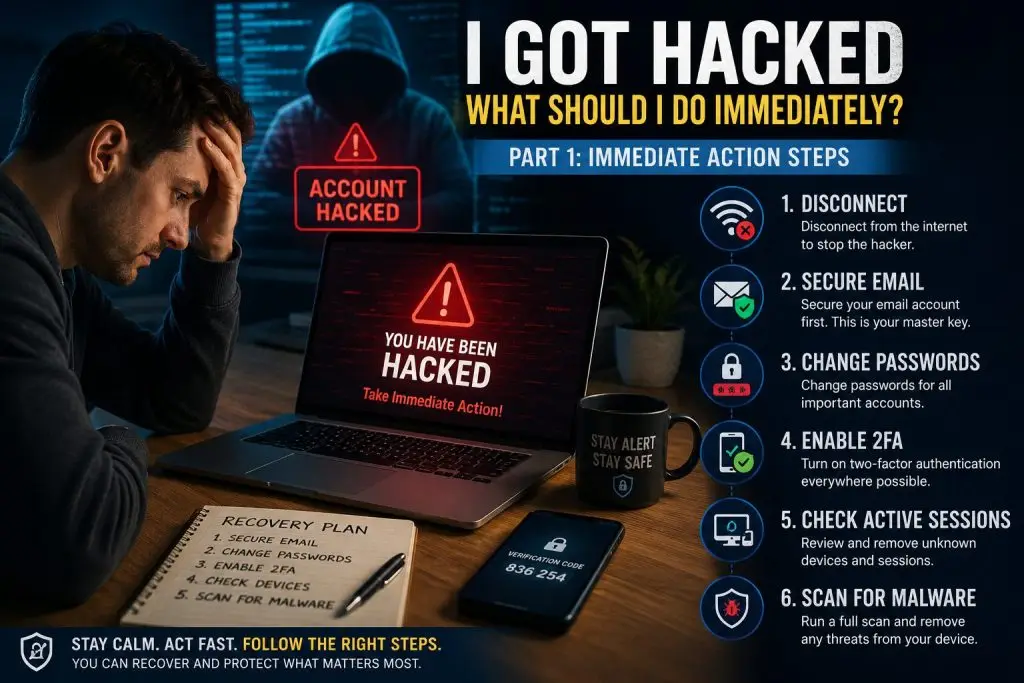
Step 1: Disconnect the Affected Device
If you suspect malware or remote access software, disconnect your computer or mobile device from the internet immediately.
Disconnect:
- Wi-Fi
- Ethernet cable
- Mobile data
- Bluetooth (if necessary)
This can interrupt active malicious connections and help prevent additional data from being transmitted.
Step 2: Secure Your Primary Email Account First
Your email account is usually the master key to all your other online accounts.
If hackers control your email, they can often reset passwords for:
- Binance
- Coinbase
- PayPal
- Online banking
- Amazon
- Apple ID
- Microsoft
If I got hacked involves your email account, securing it should be your highest priority.
Actions to take:
- Change your password using a trusted device.
- Enable two-factor authentication (2FA).
- Review recovery email addresses.
- Check forwarding rules.
- Remove unfamiliar devices from your account.
Step 3: Change Passwords Immediately
Create new passwords that are:
- At least 16 characters long.
- Unique for every account.
- Random and difficult to guess.
- Stored in a reputable password manager.
Avoid reusing passwords across multiple services.
Step 4: Enable Multi-Factor Authentication (MFA)
Multi-factor authentication significantly reduces the risk of future account compromise.
Whenever available, enable:
- Authenticator apps
- Hardware security keys
- Passkeys
Avoid relying solely on SMS verification where stronger options exist.
Step 5: Check Active Sessions
Most online services allow you to view active login sessions.
Review:
- Device names
- IP locations
- Login dates
- Browser information
Immediately sign out of unfamiliar devices.
Step 6: Scan Your Device for Malware
Run a full system scan using a reputable antivirus or antimalware solution.
Also inspect:
- Browser extensions
- Startup programs
- Scheduled tasks
- Recently installed software
Removing malicious software helps prevent repeated compromises after you’ve recovered your accounts.
I Got Hacked – How to Recover Facebook, Gmail, Instagram, WhatsApp & Other Accounts
I Got Hacked: Recover Your Online Accounts Step by Step
If I got hacked describes what you’re experiencing, your next priority is recovering your online accounts before attackers lock you out completely. Email and social media accounts often become the gateway to banking apps, cryptocurrency exchanges, shopping platforms, and cloud storage. Recovering these accounts quickly can stop hackers from causing additional damage.
Many victims searching “I got hacked” are actually looking for answers to questions like:
- My account hacked how to recover
- Facebook account hacked and password changed
- Facebook account hacked email and phone changed
- Report hacked Gmail account
- Gmail account hacked
- What to do if I’ve been hacked on Facebook
This section walks you through the official recovery process for the most common online accounts.
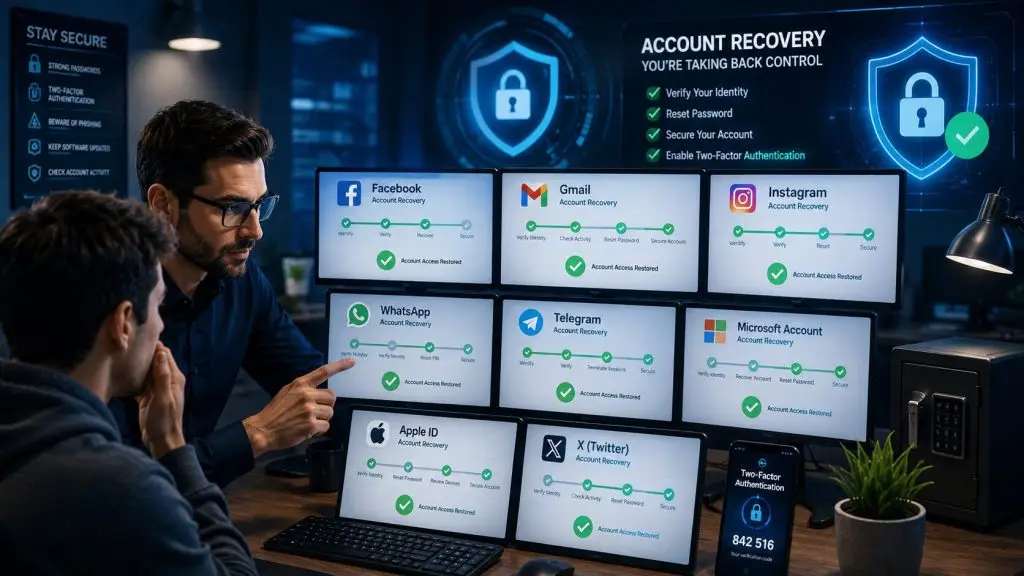
Step 7: Recover a Hacked Facebook Account
One of the most common searches is “Facebook I got hacked.” Attackers often change your password, email address, phone number, and enable their own two-factor authentication to lock you out.
Signs your Facebook account has been hacked
- Your password no longer works.
- Your email or phone number has been changed.
- Unknown posts or messages appear.
- Friends receive suspicious messages.
- Ads are running from your account.
- You receive login notifications from unfamiliar locations.
What to do immediately
- Visit Facebook’s official account recovery page.
- Search for your account using your email, phone number, or profile name.
- Secure your email account first if it was also compromised.
- Review recent login activity.
- Remove unauthorized devices.
- Enable two-factor authentication after recovery.
If I got hacked because my Facebook account was compromised, acting within the first few hours gives you the best chance of regaining control.
Step 8: Recover a Hacked Gmail Account
Your Gmail account is often the most important account to recover because it can be used to reset passwords for dozens of other services.
Signs your Gmail has been hacked
- Password changed unexpectedly.
- Unknown recovery email added.
- Suspicious forwarding rules.
- Missing emails.
- Security alerts from Google.
- Login attempts from unfamiliar devices.
Recovery checklist
- Use Google’s Account Recovery process.
- Change your password immediately.
- Remove unknown recovery methods.
- Review connected devices.
- Check forwarding settings.
- Enable Google Authenticator or passkeys.
- Review third-party app access.
If I got hacked and my Gmail account was compromised, recovering it should always come before recovering social media or financial accounts.
Step 9: Recover Instagram, WhatsApp & Telegram
Hackers frequently target messaging and social media platforms because they can impersonate you to scam friends, family, or business contacts.
Look for:
- Username changes.
- Unknown posts.
- Suspicious direct messages.
- New email address.
- Password no longer works.
Recover your account using Instagram’s official support tools and secure your linked email account.
Warning signs include:
- Verification code requested without your permission.
- Unknown linked devices.
- Friends receiving strange messages.
- You are suddenly logged out.
Immediately re-register your number on your device and enable WhatsApp’s two-step verification.
Telegram
If your Telegram account has been compromised:
- Terminate all active sessions.
- Enable two-step verification.
- Remove unfamiliar devices.
- Review connected bots and third-party applications.
Step 10: Recover Microsoft, Apple ID & X (Twitter)
Many people overlook these accounts, but they often contain sensitive personal information and are linked to other important services.
Microsoft Account
Check:
- Login history.
- Recovery information.
- OneDrive access.
- Connected devices.
Enable Microsoft Authenticator after securing the account.
Apple ID
If your Apple ID is compromised:
- Change your Apple ID password.
- Review trusted devices.
- Remove unknown devices.
- Enable two-factor authentication.
- Check payment methods and subscriptions.
X (Twitter)
If you lose access:
- Reset your password.
- Review connected apps.
- Remove suspicious API access.
- Enable two-factor authentication.
Step 11: Secure Every Other Account
After recovering your primary accounts, secure any services that may also be affected.
This includes:
- PayPal
- Amazon
- eBay
- Banking apps
- Cash App
- Apple Pay
- Google Pay
- Cryptocurrency exchanges
- Shopping websites
- Cloud storage accounts
Many people who search “I got hacked” discover that attackers attempted to access multiple accounts using reused passwords. Review every important account and update credentials where necessary.
People Also Ask
What happens if I got hacked?
If I got hacked, attackers may try to access your email, social media, banking, shopping, and cryptocurrency accounts. They may also change passwords, steal personal information, send fraudulent messages, or make unauthorized transactions. Acting quickly can help limit the damage.
How do I find my hacked account?
Review login notifications, security alerts, recent account activity, connected devices, and password reset emails. Most major services also provide login history that can help identify unauthorized access.
Can you remove a hacker?
Yes, in many cases you can remove unauthorized access by changing passwords, signing out of all devices, enabling multi-factor authentication, removing malicious software, and using the service’s official account recovery process.
I Got Hacked – Recover Your Crypto Wallet, Exchange Account & Digital Assets
I Got Hacked: What to Do If Your Cryptocurrency Was Stolen
For many victims, I got hacked means much more than losing access to a social media account—it means losing Bitcoin, USDT, Ethereum, XRP, or other digital assets. Whether your cryptocurrency was stolen through a phishing website, fake investment platform, malicious smart contract, or compromised wallet, acting quickly can improve your chances of limiting further losses.
Unlike traditional bank transfers, blockchain transactions are generally irreversible. However, that does not mean you should give up. There are practical steps you can take to secure your remaining assets, document the incident, and report it to the appropriate organizations.
This section explains what to do if I got hacked involves cryptocurrency.
Step 12: Secure Your Remaining Cryptocurrency Immediately
If hackers still have access to your wallet or exchange account, your first priority is preventing additional theft.
Immediately:
- Transfer any remaining assets to a brand-new secure wallet.
- Disconnect compromised wallets from decentralized applications (dApps).
- Revoke unnecessary smart contract permissions.
- Change passwords on all cryptocurrency exchanges.
- Enable two-factor authentication (2FA) where available.
- Review API keys and remove unknown integrations.
If I got hacked after connecting your wallet to a suspicious website, disconnecting and moving your remaining assets should be your first priority.
Step 13: Identify How the Hack Happened
Understanding the cause helps prevent repeat attacks.
Common crypto attack methods include:
Fake Investment Platforms
Victims are promised guaranteed profits before being persuaded to deposit USDT or Bitcoin.
Fake Customer Support
Scammers impersonate Binance, Coinbase, Ledger, or Trust Wallet support representatives.
Phishing Websites
Fake login pages steal exchange credentials and wallet recovery phrases.
Wallet Drainers
Malicious smart contracts request wallet approvals that allow attackers to transfer assets without asking again.
Fake Airdrops
Victims connect wallets to fraudulent websites claiming to distribute free tokens.
Malware
Keyloggers and remote access software steal passwords, seed phrases, and authentication codes.
If I got hacked, identifying the attack method will also help when reporting the incident.
Step 14: Record Every Transaction
Before taking additional action, preserve evidence.
Collect:
- Transaction Hash (TxID)
- Wallet addresses
- Date and time
- Blockchain network
- Screenshots
- Emails
- Chat conversations
- Fake website URLs
- Payment receipts
The more evidence you preserve, the easier it becomes to explain what happened to exchanges or law enforcement.
Step 15: Check the Blockchain
One advantage of cryptocurrency is that blockchain transactions are publicly visible.
Use blockchain explorers appropriate for the network:
- Etherscan (Ethereum)
- TRONSCAN (TRON)
- BscScan (BNB Smart Chain)
- Blockchain.com Explorer (Bitcoin)
You can verify:
- Destination wallet
- Transaction confirmations
- Token movements
- Wallet interactions
While this won’t reverse the transaction, it helps document the flow of funds.
Step 16: Contact the Exchange Immediately
If stolen funds were transferred to a centralized exchange, report the incident as soon as possible.
Provide:
- Transaction hash
- Wallet addresses
- Screenshots
- Timeline of events
- Police report number (if available)
Many exchanges have dedicated fraud reporting procedures. Acting quickly increases the likelihood that suspicious activity will be reviewed.
Step 17: Beware of Recovery Scams
Unfortunately, many victims who search “I got hacked” are targeted a second time by people claiming they can guarantee recovery.
Be cautious if someone:
- Promises guaranteed recovery.
- Claims they can reverse blockchain transactions.
- Requests payment upfront before providing any service.
- Contacts you unexpectedly through Telegram, WhatsApp, Discord, or social media.
- Claims to have “special blockchain software” that can magically retrieve funds.
Always verify who you are communicating with before sharing personal information or sending money.
Step 18: Secure Every Crypto Account
After the incident, review every account connected to your digital assets.
This includes:
- Binance
- Coinbase
- Trust Wallet
- MetaMask
- Ledger
- SafePal
- Exodus
- OKX
- Bybit
- Kraken
For every account:
- Change passwords.
- Enable multi-factor authentication.
- Review login history.
- Remove unknown devices.
- Check withdrawal addresses.
- Disable unnecessary API keys.
If I got hacked involved one account, assume others may also be at risk if they shared the same password or email.
Common Crypto Scams That Lead to Hacks
Many cryptocurrency thefts begin with social engineering rather than technical hacking.
Examples include:
- Fake Binance verification websites.
- Fraudulent Ledger security emails.
- Fake Trust Wallet support.
- Telegram investment groups.
- WhatsApp trading mentors.
- Romance investment scams.
- Giveaway scams.
- QR code scams.
- Clipboard malware.
- Fake wallet update applications.
Learning to recognize these scams is one of the best ways to protect yourself.
People Also Ask
Can stolen cryptocurrency be recovered?
Recovery depends on the circumstances. Cryptocurrency transactions are generally irreversible, but documenting the incident, preserving evidence, reporting it promptly, and securing remaining assets are important steps. If funds reach a centralized exchange, timely reporting may assist with an investigation.
Can a Binance account recover stolen funds?
If your Binance account was compromised, contact Binance Support immediately, secure your account, and provide all relevant transaction details. While completed blockchain transactions cannot usually be reversed, prompt reporting can help protect your account and support any review process.
Can hackers steal crypto without my password?
Yes. Attackers may gain access through phishing websites, malicious browser extensions, malware, compromised devices, or by tricking users into approving harmful smart contracts.
Can I recover my Trust Wallet after a hack?
If only the app was affected and you still have your recovery phrase, you may be able to restore access on a secure device. If the recovery phrase itself was compromised and funds were transferred, focus on securing remaining assets and documenting the incident.

I Got Hacked – Frequently Asked Questions, Long-Term Protection & Recovery Checklist
I Got Hacked: Frequently Asked Questions
If I got hacked brought you to this guide, you’re not alone. Millions of people every year lose access to email accounts, social media profiles, financial accounts, and cryptocurrency wallets because of phishing, malware, weak passwords, fake websites, or social engineering attacks. The good news is that acting quickly and following trusted recovery procedures can help you regain control and reduce further damage.
Below are answers to the most common questions people ask after discovering their accounts have been compromised.
What Happens If I Got Hacked?
If I got hacked, attackers may attempt to:
- Change your passwords.
- Lock you out of your accounts.
- Access your email.
- Steal banking information.
- Drain cryptocurrency wallets.
- Send fraudulent messages to your contacts.
- Make unauthorized purchases.
- Collect personal information for identity theft.
The sooner you secure your accounts, the better your chances of limiting additional losses.
What Is the First Thing You Do When You Get Hacked?
If I got hacked, take these immediate actions:
- Disconnect the affected device from the internet if you suspect malware.
- Secure your primary email account.
- Change passwords using a trusted device.
- Enable multi-factor authentication.
- Sign out of all active sessions.
- Contact your bank or exchange if financial accounts are involved.
- Preserve evidence such as screenshots and transaction IDs.
Can You Remove a Hacker?
In many cases, yes. You can often remove unauthorized access by:
- Resetting passwords.
- Removing unknown devices from your accounts.
- Enabling MFA.
- Scanning your device for malware.
- Removing suspicious browser extensions.
- Using official account recovery tools.
If a device remains compromised after these steps, consider resetting it and restoring only from trusted backups.
How Do I Find My Hacked Account?
Review:
- Security alert emails.
- Login history.
- Connected devices.
- Password reset notifications.
- Recovery email changes.
- Phone number updates.
- Banking and cryptocurrency transaction history.
Most major online services provide a security dashboard where you can review recent account activity.
How Do I Know the Hacker Is Gone?
Signs that your accounts are secure include:
- No new unauthorized logins.
- Password changes remain effective.
- Two-factor authentication is active.
- No unknown devices appear in your account.
- No suspicious emails or password reset requests.
- Antivirus scans report no active malware.
- Your contacts stop receiving suspicious messages.
Continue monitoring your accounts for several weeks after recovery.
Can Stolen Cryptocurrency Be Recovered?
If I got hacked and cryptocurrency was stolen, remember that blockchain transactions are generally irreversible. However, you should:
- Secure any remaining assets.
- Record transaction hashes.
- Preserve evidence.
- Report the incident to the relevant exchange if applicable.
- File a report with the appropriate authorities in your jurisdiction.
- Monitor wallet activity using public blockchain explorers.
Avoid anyone who guarantees they can reverse a blockchain transaction or recover funds for an upfront fee.
How Can I Prevent Future Hacks?
Cybersecurity is an ongoing process. Follow these best practices:
- Use unique passwords for every account.
- Store passwords in a reputable password manager.
- Enable MFA wherever possible.
- Keep devices and software updated.
- Verify website URLs before logging in.
- Avoid clicking suspicious links.
- Never share recovery phrases or private keys.
- Regularly review account security settings.
- Back up important data.
- Stay informed about phishing and social engineering tactics.
Your Complete Recovery Checklist
Use this checklist after any suspected compromise:
✔ Disconnect the affected device if necessary.
✔ Secure your email account.
✔ Change passwords.
✔ Enable MFA.
✔ Sign out of all devices.
✔ Scan for malware.
✔ Review account activity.
✔ Secure financial accounts.
✔ Secure cryptocurrency wallets and exchanges.
✔ Preserve evidence.
✔ Notify affected contacts if necessary.
✔ Continue monitoring accounts.
Helpful External Resources
For official recovery and cybersecurity guidance, consult trusted sources such as:
- Google Account Recovery
- Facebook Help Center
- Microsoft Account Recovery
- Apple Support
- Binance Support
- Trust Wallet Support
- National Cybersecurity agencies in your country
Use official support pages rather than links shared through unsolicited emails or messages.
Related Articles
You may also find these guides helpful:
- Recover Lost Bitcoin
- Recover Lost USDT
- Recover Scammed Cryptocurrency
- Recover Crypto Sent to the Wrong Address
- USDT Recovery Guide
- Cryptocurrency Scam Prevention
- Flash USDT Explained
- Crypto Wallet Security Best Practices
Conclusion
If I got hacked, remember that your response in the first few hours can make a significant difference. Secure your accounts, change your passwords, enable multi-factor authentication, preserve evidence, and use only official recovery channels.
While recovering from a hack can be stressful, taking a structured approach helps you regain control and reduce the risk of future incidents. Continue monitoring your accounts, strengthen your security habits, and stay alert to phishing attempts and recovery scams that often target victims after an initial compromise.